SEC 17a-3 and 17a-4: Capture Texts the Right Way
Your advisors text clients. The phone is simply where business moves fastest now. And SEC Rules 17a-3 and 17a-4 hold your firm responsible for creating and preserving those business records, no matter which app carried the message.
So the real question is not whether your people text about business. It is whether you can capture what they send and keep it the way the rules require.
The short answer
SEC Rule 17a-3 sets out the records a broker-dealer must create. SEC Rule 17a-4 sets out how long to keep them and how to preserve them. Business communications are records regardless of the device or app used to send them, so a business text or chat is a record like any business email. Many records carry a six-year retention, with the two most recent years kept readily accessible. The SEC’s electronic-recordkeeping amendment guide explains the current standard.
In plain terms, if your people text about business, your firm must capture those messages and preserve them in a usable form. A firm cannot preserve what it never captured, so compliance starts with capture.
17a-3 creates the record. 17a-4 preserves it.
17a-3 is creation. It names the records a broker-dealer must make and keep current, from blotters and order tickets to customer records and, today, the business communications that move on mobile devices.
17a-4 is preservation. It sets how long those records live and how they must be stored and produced. The October 2022 amendments, effective for broker-dealers on May 3, 2023, modernized this. Firms may now use a complete, time-stamped audit-trail system as an alternative to the older write-once-read-many format, and records must be produced in a reasonably usable electronic format. The SEC’s amendment guide and the rule text carry the detail.
Create the record under 17a-3. Preserve it under 17a-4. Both depend on capturing the message first.
Why books and records gets quietly difficult
Here is the tension most firms feel. Recordkeeping sounds like a storage problem, but it is really an adoption problem.
Naturally, people gravitate to the apps they already use. When a capture tool feels clumsy or foreign, a few users quietly route around it. They move a fast client question to a personal thread, just once, just to be helpful. Coverage erodes slowly, not through bad intent, but through ordinary human behavior.
But each message that never gets captured is a 17a-3 record your archive never holds. And a books-and-records system with blind spots is the exact gap these rules exist to close. The exposure does not come from a villain. It comes from a poor tool fit, then low adoption, then drift.
You can capture mobile, and you do not have to ban it
Here is the good news. You do not have to choose between letting advisors text and meeting your 17a-3 and 17a-4 obligations. We capture the channels your people actually use, and we deliver every message into the archive you already run.
We compliantly capture iMessage, Android and RCS, SMS, and WhatsApp, with no change to how people text. Blue bubbles, reactions, media, and attachments are all included. The only open question is which mix fits your firm, and a Solutions Team expert maps the right one with you on a quick call.
How capture meets 17a-3 and 17a-4
The mechanic is deliberately simple, so it earns the adoption recordkeeping depends on.
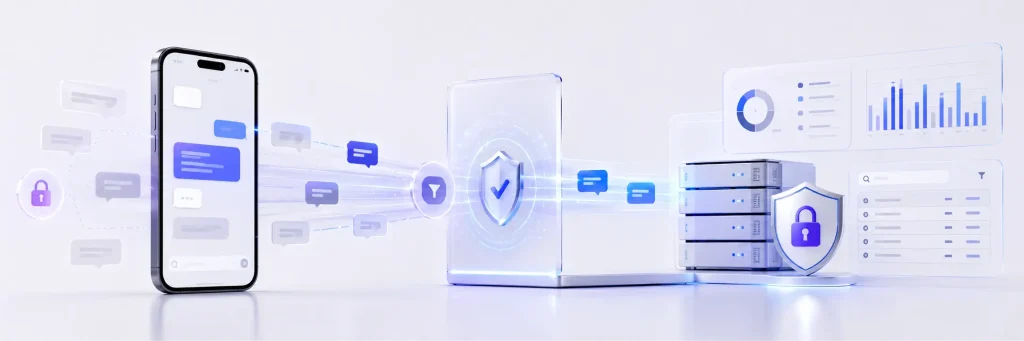
We capture the message.
Native capture pulls in business texts across iMessage, Android, RCS, and WhatsApp Business and Messenger, including group chats, media, reactions, and edited or deleted messages. There is no third-party app changing the texting experience your advisors expect.
We convert it to a usable record.
Every captured message becomes an email-format record, which fits the rule’s call for a reasonably usable electronic format. The subject line flags the message type, iMessage, SMS, or WhatsApp, so a search can be scoped to mobile in seconds. The To and From line shows the participant numbers, with the employee side enriched with their name and corporate email.
We deliver it to your archive.
This is the part a single-archive vendor cannot match. We are archive-agnostic. We deliver captured messages into industry-leading archives like Intradyn, or any other you already run. Nothing to rip out, nothing to refit. You can even deliver to more than one archive for redundancy. Your records stay in the system you already trust for 17a-4 preservation.
A few honest limits keep the picture accurate. Capture covers WhatsApp messages, media, and metadata, not calls placed inside the WhatsApp app. WhatsApp registration accepts major-carrier US cell numbers, and landlines for the Business App, so VoIP and toll-free numbers cannot register. For corporate-owned devices, carrier-level capture works with nothing for employees to install, though it runs business texting as standard SMS and turns off iMessage and RCS, and it needs a corporate billing plan rather than a personal or family plan. And where you need business-only coverage, selective and whitelist capture keeps personal messages private, which keeps adoption high and privacy intact.
Where 17a-3 and 17a-4 fit the wider rulebook
These two rules rarely travel alone. They sit at the center of a broader recordkeeping web.
FINRA Rule 4511 requires member firms to make and preserve books and records, with a default retention of at least six years where no other period applies, in a format that complies with the SEC standard (see our guide to FINRA 4511 retention). In effect, 4511 pulls 17a-4 into the FINRA rulebook and applies it broadly to business communications. The rule lives on FINRA’s site.
Registered investment advisers fall under a related but narrower retention rule, Investment Advisers Act Rule 204-2, so the same capture-and-preserve logic applies to advisory firms. Beyond these, the same obligation runs through other applicable recordkeeping, retention, and supervision regulations, which is why capturing the message once and preserving it properly is the durable answer.
The urgency here is real, and it is worth stating calmly. Since 2021, regulators have charged more than 100 firms and collected over $3 billion in penalties for recordkeeping failures tied to off-channel communications. In one action in August 2024, the SEC charged 26 firms with more than $390 million in combined penalties, detailed in its press release. Notably, regulators have pointed to firm-approved, captured messaging as the remedy. The lesson is not to ban mobile. It is to capture it properly.
The bottom line
Before, business texts lived on advisors’ phones, never created as records under 17a-3 and never preserved under 17a-4. After, every business message across iMessage, Android, and WhatsApp is captured, converted to a usable record, and delivered into the archive you already trust.
You keep your archive. Your advisors keep texting the way clients expect. And your firm finally creates and preserves the records it is responsible for. Capture runs about a third the cost of an iPhone, and the fit is the only thing left to map.
This article is general information and education only, not legal or compliance advice. FINRA and SEC requirements change, and how they apply depends on your firm and situation. Confirm current obligations with your own qualified compliance or legal counsel and the primary regulations before you act.
FAQ’s
SEC 17a-3 and 17a-4 FAQ
What is the difference between SEC Rule 17a-3 and Rule 17a-4?
Rule 17a-3 sets out the records a broker-dealer must create. Rule 17a-4 sets out how long to keep them and how to preserve and produce them. One creates the record, the other preserves it, and both apply to business communications. The SEC’s amendment guide covers the current electronic-recordkeeping standard.
Do SEC Rules 17a-3 and 17a-4 cover text messages?
Yes. Business communications are records regardless of the device or app used to send them. If an advisor texts a client about business, on iMessage, SMS, or WhatsApp, the firm must capture and preserve that message like any business email.
How long must broker-dealers keep records under 17a-4?
Many records carry a six-year retention, with the two most recent years kept readily accessible, though some record types run shorter. Confirm the period for your specific records against the rule text and your own counsel.
Did the 2022 amendments end the WORM requirement?
The October 2022 amendments, effective for broker-dealers on May 3, 2023, let firms use a complete, time-stamped audit-trail system as an alternative to the write-once-read-many format, and require records in a reasonably usable electronic format. The SEC amendment guide explains it.
What happens if a firm fails to preserve off-channel messages?
Regulators treat uncaptured business messages as a recordkeeping failure. Since 2021, they have charged more than 100 firms and collected over $3 billion in penalties for off-channel failures. One example is the SEC’s August 2024 action against 26 firms.
Can we capture iMessage and WhatsApp without banning them?
Yes. You can capture iMessage, Android, RCS, and WhatsApp natively, convert each message to an email-format record, and deliver it into the archive you already run, so creation and preservation stay one workflow.
Start The Conversation
See the easily adopted, flexible, and affordable options.
Business-only, audit-ready mobile capture for any firm size, any device type, and any budget.
Related Guides
Record keeping and supervision guides
These guides go deeper on the rules, retention periods, and capture methods that sit alongside SEC 17a-3 and 17a-4, so you can see how the full record keeping picture fits together.
- Broker-dealer complianceThe hub guide to a firm’s full record keeping duty, and where business texts fit in.
- FINRA 4511 retention requirements How FINRA pulls the SEC preservation standard into its own rulebook, with the default six-year period.
- FINRA 3110 supervision The supervision half of the pair, and why you have to capture messages before you can review them.
- RIA compliance for texting How the same create-and-preserve duty reaches investment advisers under the Advisers Act.
- Archiving iMessage for business Why iMessage evades carrier capture, and how to preserve it in full for your 17a-4 archive.
- Off-channel communications The enforcement backdrop behind the record keeping rules, and what regulators expect firms to capture.